
Career Choices in Health Administration

The American healthcare industry is vast when measured on almost any scale. It handles more than 36 million hospital admissions annually according to the American Hospital Association, and books outpatient appointments and consultations for hundreds of millions more. According to a Brooking’s Institute report from 2019, the industry accounts for 24 percent of government spending and employs 11 percent of all American workers, more than 16 million jobs… one out of every eight workers in the country.
And then there’s the health insurance industry, which delivers almost a quarter of all non-wage compensation paid out to Americans each year. Think of that for a minute – health insurance payouts are equal to a full 25% of all the social security, veterans benefits, social assistance, private pensions, interest, dividends, annuities and other similar investment products paid out in the United States every year. At the same time, individual consumers still put more than 8 percent of all their spending toward health care, averaging more than $10,000 apiece every year.


If there’s anything you can be sure about, it’s when that many patients are being seen and managed, and that much money is floating around, there is a lot of administration work required to make it happen. And that means a lot of healthcare administration jobs to fill.
Making career choices in an industry this flush with money and a field like health administration with so many opportunities is no small task. Not only does it include several major employment sectors of its own, but there are also dozens of administrative specialties that can be combined with dozens of medical specialties to create hundreds of totally unique career paths. All of those paths can depend on education, experience, and your personal circumstances… every decision you make from the time you graduate high school to the time you pick out a doctoral dissertation topic will influence the trajectory of your career in this fast-moving and ever-changing industry.
The things you know about a career in healthcare administration is that it will be exciting, fast-paced, and offer you every opportunity to help people who need and deserve quality care. Everything else may be up in the air.
Challenges in Picking a Health Administration Career Path

If there is one thing you can count on in any healthcare job, it is that your carefully planned career will be thrown off the tracks at some point by rapid changes you may not even see coming. Healthcare administrators, in only the past two decades, have had to deal with some epochal shifts in the industry:
- Compensation and coverage changes, and shifts in the patient population stemming from the Affordable Care Act in 2010
- The first genetically targeted therapies emerging after the successful sequencing of the human genome in 2000
- Widespread adoption of electronic health records (EHR) stemming from a 2004 initiative from the Bush administration
- Major shifts in treatment and sanitary procedures driven by the rapid rise in healthcare-associated infections such as MRSA
- Whiplash demands on providers, supply chains, and administrative processes driven by the COVID-19 pandemic
That’s all in about half the timeline of a typical career in the field.
There’s no telling what’s just around the corner for healthcare administration professionals. Some of the most high-demand careers in the field didn’t exist a generation ago until big changes in technology and regulation came along to give rise to entirely new domains like healthcare informatics and electronic health records. In a decade, other entirely new roles may emerge, while others may fade into the background.
A Change-Driven Industry Demands Highly Educated Administrators
There’s no sure way to predict exactly what kind of changes you will see in the industry during your lifetime, but there are some trends that future healthcare administration professionals should be watching and preparing for to stay relevant:
Emerging Threats Require More Planning – COVID-19 isn’t gone, and it’s probably not the last pandemic you will see in the course of your career (although we can all hope it represented the worst); population pressures and climate change continue to drive new healthcare threats. And much remains uncertain about the prognosis for millions who survived the coronavirus, as well; 30 percent of hospitalized patients were found with moderate or severe kidney injuries. Could it mean a wave of organ failures in ten or twenty years time? Administrators have to be ever-vigilant and prepared for the possibility of new healthcare threats.
Information Technology Changes Treatments – Although EHRs are already becoming common in the industry, they are just the tip of the iceberg when it comes to the potential for information technology to drive innovation. AI-diagnostics, data-mining to discover healthcare trends and new drugs, micro-implants and nano-tech organ repair… all of them are on the horizon and each individually could completely overturn conventional treatment modalities.
Evolving Patient Population Needs – The fact that the Baby Boom generation is creating a vast wave of geriatric care concerns for the American healthcare industry is, at this point, old news. But less noticed outside the industry is a similar demographic shift in patient population that will challenge many of the expectations and conventions in modern American healthcare. It’s driving a need for new culturally-aware healthcare practices – everything from language and religious considerations to accommodating different dietary needs and preferences.
Uncertain Political Landscape Threatens Systems – COVID-19 also exposed extreme fractures in the healthcare system, from shaky supply chains to broken public health warning and prevention systems. Court fights, even during the worst of the pandemic, to repeal the ACA showed deep disagreements over how healthcare in America should be paid for and how many Americans should even be covered. If ACA’s passage was a sea change in the healthcare system, its repeal will be equally consequential for healthcare providers. The regulatory and financial uncertainty in the system today is a constant concern for administrators.
These trends – and others that may not even have been identified yet – will all play some part in changing the course of your career in healthcare. It’s a wise idea to pick a path that’s likely to keep you ahead of the curve, but it’s also smart to stay flexible enough to be able to adjust course as changes emerge.
The Right Health Administration Degree for the Career You Want
Being ready for the career you want, and anything that might come your way during the course of that career, always starts with getting a college education. Not only is college your ticket into the industry, but it’s also your best insurance for longevity. That’s because college degrees not only give you the specific knowledge you need for healthcare administration, but they also deliver something that’s just as valuable: the capability to continue learning long after graduation.
At a minimum, this will demand at least a couple years of intensive study; at the top end of the profession, you could find yourself spending more than a decade in school.
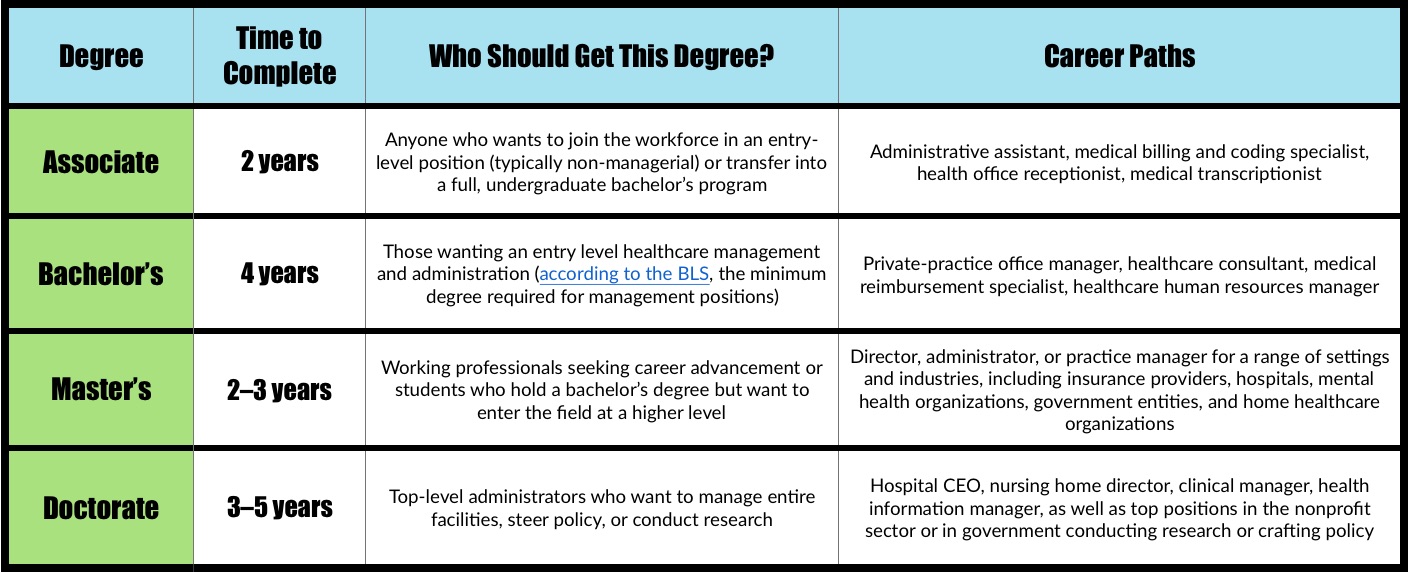
Your degree choice is not a one-shot deal, though. It’s better to think of it as a ladder, with lower degrees opening the gateway to higher degrees. You don’t have to decide right away what your end goal will be. It might even be a mistake to do so, before getting first-hand exposure to the work. After a number of years in the field you may very well decide that you want to move up to a more senior position, and the good news is that you’ll have the degree options to make that happen.
Even if you keep moving up the ladder, you’re very unlikely to do it all in one throw… while it’s fairly common to transition from an associate program directly to a bachelor’s degree, in all other cases you will usually be expected to put in some time actually working in the industry to build your experience before going after more advanced degrees like the MHA or DHA.
Health Administration Degree Levels Explained
In addition to the time required and the jobs they will qualify you for, you’ll find that there are some differences in how degrees at each level are designed and what the educational goals look like.
Associate – Associate degrees are designed to provide both basic preparation for entry-level healthcare administrative services jobs and to serve as a stepping-stone into a bachelor’s degree. It makes sense to think of them as the first half of a bachelor’s, in fact, since a fully transferable associate program will count for approximately half of a bachelor’s degree. That means in addition to the healthcare and business principles you will learn, they also include basic liberal arts and general education courses, such as English, social studies, and math.
An associate degree can prepare you for job titles that include:
- Administrative Assistant
- Medical Billing and Coding Specialist
- Health Office Receptionist
- Medical Office Scheduler
- Medical Transcriptionist
Bachelor’s – In addition to offering specialized knowledge in administrative methods and processes that go on behind the scenes in healthcare organizations, bachelor’s programs are designed to offer a general well-rounded education in the arts and sciences. Continuing from the base of an associate program (or including similar coursework if you did not earn an associate degree first), that means a sequence of required classes that are designed to give you a range of general knowledge and to improve your critical thinking and communication skills.
A bachelor’s degree can prepare you for job titles that include:
- Practice Manager
- Medical Office Business Consultant
- Billing and Reimbursement Specialist
- Human Resource Manager
Master’s – Whether you’re going for the coveted MHA (Master of Health Administration) or an MBA with a focus in health administration, master’s programs require you to have a bachelor’s degree under your belt, and forego the larger liberal arts perspective in favor of a highly specialized education that is directly pertinent to healthcare administration knowledge and skills. The classes are small, there is more one-to-one interaction with instructors, and your course of instruction will be more self-directed, angled toward completing thesis work in an area that you have selected for yourself.
An MHA or MBA can prepare you for administrative, management, director and even executive level job titles in a variety of settings and industry sectors. Some of the most popular among them are:
- Insurance Provider Administrator
- Hospital Administrator
- Pharmaceutical Sales Administrator
- Clinical Research Administrator
- Assisted Living and Elder Care
- Hospice Administrator
- Medical Office Manager
Doctorate – Either a PhD or practice-focused Doctor of Health Administration (DHA) degree will put you on the cutting-edge of healthcare administration studies, involving original research as well as deep investigations into the latest theory and thought in the field. Even more than at the master’s level, you are expected to drive your own program at this level, with as much as a year of your studies almost entirely devoted to researching and writing a doctoral dissertation that involves original research and novel ideas, which you will have to defend in front of a committee of experts in the field.
A PhD is generally more geared toward working in academia and research, while a practice-focused DHA puts you in the running for top level director and executive positions:
- PhD – Philosophy degrees are only found at the doctoral level, and emphasize research above everything else. They are considered terminal degrees, so represent the highest level of study in the field, but they are intended primarily to prepare future college instructors and high-caliber researchers rather than actual healthcare administrators.
- DHA – Doctor of Healthcare Administration programs are considered terminal degrees as well, but they are applied doctorates: an advanced level of study that is aimed at execution and leadership more than research. They will look at real-world case studies and consider problems of actual service delivery more than research and education matters.
The job titles you can compete for with a DHA won’t necessarily be categorically different from the positions you’d have access to with a master’s, but it may put the executive positions a bit more within reach, including facility and system CEO positions.
Health Administration Degree Specializations

Degrees have different specializations baked into them, which are usually quite clear based on the title. There are dozens of these in healthcare administration, some of them only available at certain degree levels; health informatics, for example, can be found in bachelor’s or master’s offerings, but not as an associate. And naturally, the degrees generally become more and more specialized the more advanced it is.
They may also be modified by concentration or specializations offered by the school, so you can find a Master of Science in Healthcare Administration with specializations in accounting, finance, human resources, project management, or dozens of other areas.
Other concentrations can include:
- Global Health – Education in international healthcare delivery, service, and supply
- Health Informatics – Cutting-edge information technology approaches to health systems
- Acute Care – Focus on the meat and potatoes hospital and clinic administration elements of healthcare management
- Long Term Care – Prepares students for work as administrators in geriatric, mental health, or rehabilitation care facilities
- Patient Safety and Quality – Drills down on safety and security processes in all phases of healthcare, including monitoring and improvement programs
- Health Promotion/Marketing – Uncovers the aspects of advertising and marketing services to either healthcare clients or populations
There are also a number of degrees in other areas that offer healthcare concentrations that will prepare you just as well for a career in healthcare administration. Degrees in business, particularly MBAs with concentrations in healthcare management, are very common among the ranks of current healthcare executives.
Other such common majors that may have healthcare management tracks include:
- Master of Public Health
- Bachelor/Master of Science in Health Science
- Bachelor of Business Administration
- Doctor of Health Services
- Doctor of Business Administration
Finally, many of these programs are available as dual degrees. In other words, you can simultaneously pursue two different bachelor’s or master’s degrees in different, but related major areas that are complimentary. It’s most common to find this sort of arrangement between a general degree, such as an MBA, and a highly-specialized aspect of healthcare management, like Mental Health Administration or similar.
As you can see, it’s not just the level of education that will determine what kind of role you can take on in healthcare administration, but also the subject and focus of that degree program.
Online and Traditional Healthcare Administration Programs Exist at Every Level

Even before COVID-19 upended both college and healthcare, online degree programs were becoming more and more common. Today, at the master’s level especially, they are maybe even more common than traditional, on-campus programs.
You’ll find your options wide-open, though, so you’ll have to make a decision as to how you want your curriculum delivered – in-person or online. There are pros and cons to each:
Pros for Online Healthcare Administration Degrees
- No need to relocate: With remote learning, you can pick the college you’ve always dreamed of attending even if it’s halfway across the country, all while you stay right where you are.
- Study when you want: Most online degrees are offered with asynchronous classes, which means you can attend class in your PJs at 2am and no one will be the wiser.
- Keep your current commitments: That flexibility also allows you to keep your current job, since class hours won’t necessarily cut into work hours, or keep up with family obligations.
- Keep costs low: Some online programs are offered at a lower cost than traditional studies; without having to pay for classrooms, utilities, or other on-campus costs, colleges can deliver these more efficiently.
Cons of Online Healthcare Administration Degrees
- You need fast, stable internet: Since all your classwork is arriving over the internet, and all your homework is turned in the same way, you’ll be out of luck without a fast, consistent internet connection.
- Classrooms create focus: For some people, it’s just easier to get into the right frame of mind to study in a traditional classroom environment. Online courses can’t offer that.
- Missing in-person contact: Similarly, some people learn better when they are interacting in person with instructors and fellow students. A video connection isn’t quite the same thing.
- Too much going on at home: Learning at home assumes you have a quiet space to yourself for focus and study. But that’s not true for everyone, so a traditional college campus might be a better choice in that case.
Of course, those aren’t always the only two choices. Many programs are actually hybrid offerings now, which combine some elements of on-campus attendance for certain classes and team projects with classmates, while the bulk of classes and participatory coursework is delivered online. These blended programs frequently deliver the best of both worlds, offering classes that are easily absorbed remotely, minimizing your attendance requirements, while still offering more involved projects in-person.
Health Administration Careers
We can only give you a taste of the many different career options that are open in the world of healthcare administration. By the time you finish your education, there will probably be many more. And you might even forge ahead and create your own new path in the field as new technologies and new challenges make other administrative careers available.
But these are a representative sample of some of the titles, paths, and salaries that you can find in the American healthcare industry as of October of 2020:
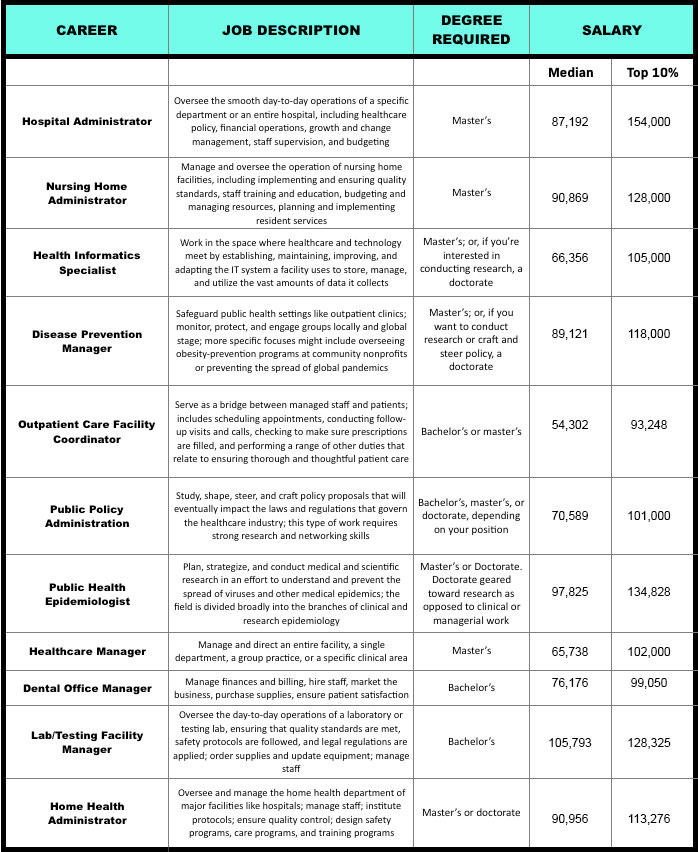
Salary data accessed 11/5/2020
You’ll notice that many of these positions are accessible from a variety of different educational backgrounds. But the level of degree is not the only consideration; you’ll also need to consider the specialization of the program.
Which Health Administration Career Option Is Right For Me?
We have already dumped a lot of information on you about healthcare education and careers. But information doesn’t make the decision for you. Although there are very real calculations you will have to make before deciding on a degree program you can afford, the most important decisions have to do with where your interests are and what you enjoy doing from day-to-day on the job.
This table gives you some idea of the level of education you need for different career paths, but also some of those key features that weave the fabric of your daily experience in each of those roles:
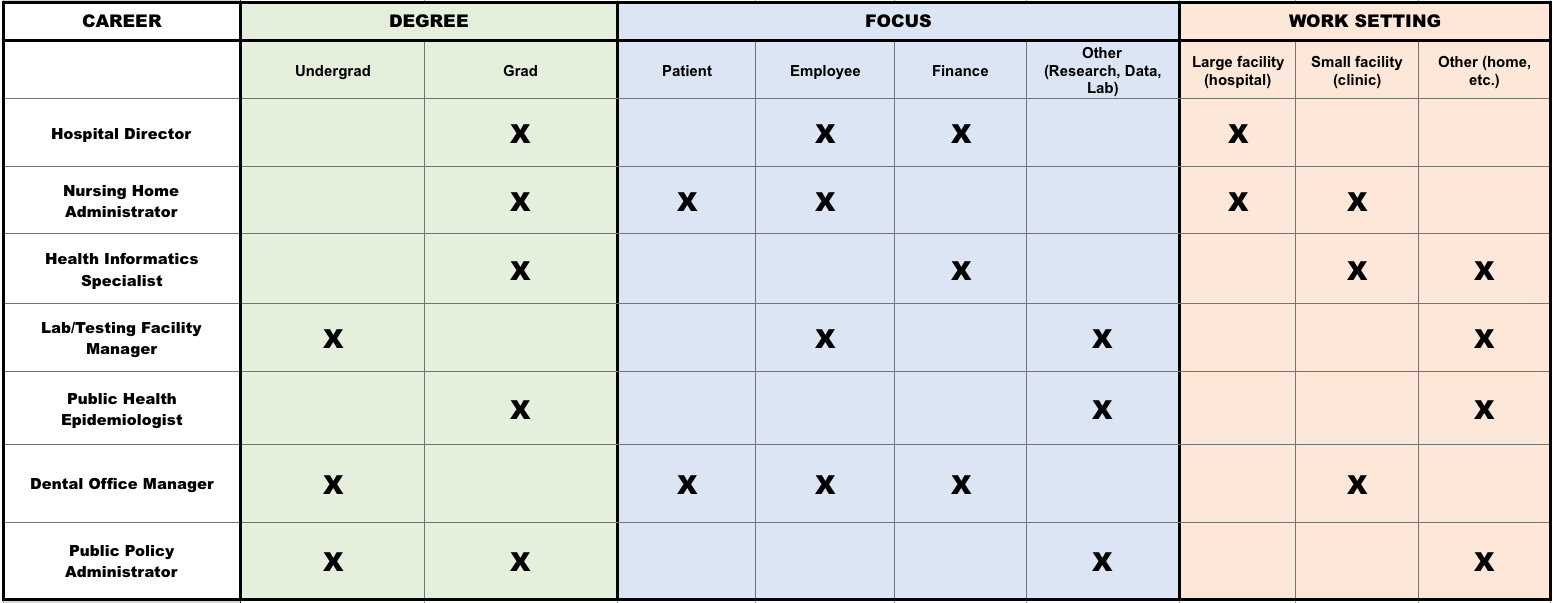
To a great extent, it all comes down to focus and setting. You’ll choose among these depending on your preparation and personality. Is working directly with patients more your style? Or does supporting doctors and nurses line up better with your interests? You want to spend your days in a big, busy hospital, or a small neighborhood clinic where you get to know all your regular patients? Or do you enjoy working behind the scenes, crunching the numbers and making big decisions that will influence how millions of dollars in resources are allocated and helping thousands or people who will never even know you exist?
Healthcare Administration Focus Areas

Patient Focus: These roles operate in management closer to where the action happens in patient care settings. Administrators here may or may not have a lot of direct patient contact, but they do spend most of their time considering operational details that have a lot of impact on the patient experience and treatment outcomes.
That includes keeping up with the latest developments in treatment and making sure facilities have the necessary equipment and supplies. During the pandemic, patient-facing healthcare administrators were working overtime to overcome shortages in 29 of the 40 basic drugs used in COVID-19 treatment, according to the Center for Infectious Disease Research, as well as undertaking crash programs to expand ICU bed capacity in places like fairgrounds and sport stadiums.
In less chaotic times, these admins spend their days reviewing paperwork on outcomes, overseeing deep-cleaning and infection control processes, and coordinating with emergency medical services and other facilities for patient transfers and treatment. They also take care of more basic considerations in patient care, like feeding, intake and discharge paperwork handling, and essential physical plant considerations like heating and cooling systems. Regulatory compliance is also a big focus in patient treatment, so these executives have to stay up-to-date on requirements and monitor their facilities to make sure all processes are in line.
Employee: Staffing and labor relations are the big daily concerns for administrators with this focus. In an industry that is expected to see a shortage of as many as 45,000 primary care providers by 2030 according to estimates from the American College of Physicians, recruiting and retention are a constant concern in these roles. Employee-focused admins draw up schedules, deal with time-off requests, handle training considerations like bringing in continuing education seminars and speakers to keep staff up on the latest information in their respective fields.
They are the ones responsible for making basic work assignments from day-to-day, deciding which staff are the right fit for certain assignments, and following up to make sure the job has been done and done properly. They also field requests from staff to deal with everything from pay raise requests to new equipment or operating procedure changes.
All of this adds up to spending a lot of face time with both direct reports and other managers in the organization. Networking and recruiting efforts are also high on the list to help keep staffing levels up and bring in the best people for the jobs at hand.
Finance: Finance-focused executives and administrators spend much of their time staring at spreadsheets and billing forms. They may ensure that documentation is in order to comply with billing procedures from insurance companies, or they may be on the other end of that, at insurance companies themselves, evaluating and approving or rejecting charges.
Budgeting is important in all aspects of healthcare, where a lot of money is floating around but margins may be tight. Finance professionals help forecast demand and income, and work with other managers to build out realistic budgets to make sure everything adds up.
The finance team is also sometimes the bearer of bad news; when the state of Tennessee converted its Medicaid program over to a managed care model, St. Joseph Hospital and Healthcare Centers found it had to cut expenditures by $8 million year-over-year. Working with consultants, the financial team worked out how to break that down into layoffs resulting in $6 million in savings, dropping 162 jobs in the process.
Other (Research, Data, Lab): These roles represent the more technical side of healthcare administrative work. They may not involve any supervisory work at all; instead, the focus could be on developing reports and data collection procedures in an informatics position, or conducting large-scale surveys of the public or medical providers to gather information for public health policy development.
This is a grab-bag of jobs that may not have a lot in common, but also don’t necessarily have a lot in common with other focus areas. An epidemiology administrator, for example, can expect to work a lot with other public health officials and agencies, and maybe even act as the public face of their organization to the media. A testing facility manager, on the other hand, might not see much more than machinery on many days, and spend more time writing and reading reports than talking with people.
Healthcare Administration Work Settings

Large Facility (hospital or care center): Big facilities tend to mean more specialization for healthcare administrators. You are likely to have concerns that are fairly narrowly defined within the department you manage, and your daily tasks can vary a lot depending on what department that is… an oncology department supervisor will have a very different day than the housekeeping manager.
Big facilities also tend to have more rules, which is a mixed bag for administrators. On the one hand, that’s more administration work, with more job security. On the other hand, it will sometimes keep you in a pretty narrow lane, working with mostly the same people day in and day out on a fairly specific number of tasks.
Small Facility (clinic or physician’s office): In small offices, on the other hand, you’ll find that you have more flexibility and often more authority. You’ll get a chance to stick your nose into almost every aspect of running the facility, and get to know the staff more directly and informally.
Small facility administrators may not have all the resource or professional glitz that goes along with big hospital jobs. And because they shoulder more of the load, it can be a high-stress position with few other professionals to lean on in crunch time.
Other (office, lab, or remote): Administrators who work at independent labs, government agencies, or non-profits are more likely to spend their days in a typical office environment. Some, however, can spend a lot of time out on the road, visiting other healthcare facilities or companies. And of course research and lab settings offer a very different environment, with tools and technology in the foreground, it’s generally a more hands-on setting.
Consultants can find themselves working in any and all of the above settings in the course of their daily work, an excellent choice for anyone who doesn’t really want to make a choice… you can get a little bit of everything in such positions.
And many administrative professionals who work in advocacy or policy shops will spend some part of their time in legislative settings, working with lawmakers and their staff on all kinds of healthcare matters.
The Core Functions That Health Administrators Handle

Although you’ll find some of these emphasized more or less in different specializations and focus areas, almost every healthcare administrator engages in a number of similar tasks to a greater or lesser degree:
Finance – Administrators almost always need to be concerned about money. Whether it’s basic management of co-payments or developing budgets for multi-million dollar capital projects, you can expect to spend a fair amount of time with your nose buried in Excel spreadsheets in just about every healthcare management career.
Human Resource Management – Some careers do not involve direct supervision of staff, but most healthcare administrators will have some responsibility for overseeing subordinates at some point. Basic HR tasks like managing sick leave, recommending raises, counseling problematic employees, and other jobs will be on your plate.
Communication and Public Relations – Similarly, some administrators don’t ever have to deal with the public. But communications tasks are integral to good management, whether you spend your time coordinating with local media outlets or just staying on the same page as other department heads.
Regulatory Compliance – Every aspect of American healthcare is regulated in some respect, and rightly so; it is those high standards that make our quality of medical care some of the best in the world. Managers have to be familiar with the rules and observe and ensure compliance with them among staff.
Supplies and Equipment – Few medical departments don’t use any kind of supplies, whether it’s printer paper or catgut sutures. Administrators are responsible for reviewing those needs, making sure stocks on hand are sufficient, and evaluating and updating gear when necessary.
Meetings – All of this coordinating and communicating happens by email, text, and phone at times, but in any modern American business, you will spend a lot of time in meetings. Managers in all roles have to be adept at presenting and running group meetings.
General Troubleshooting – One of the biggest but most unsung roles for any manager is just making sure the business of the department stays on track. Much of any day on the job for managers is spent uncovering information about problems, finding the right resources to solve them, and getting those resources into the right hands.
Planning – When any responsible manager actually has five free minutes of time to rub a few braincells together, that time is likely going to be devoted to planning. Much of what makes a department successful tomorrow comes down to groundwork that is laid today, so managers have to look ahead and develop long-term goals and ideas to stay ahead of the game.
Continuing Education – Finally, managers at all levels and in all roles benefit from continuing education. In a fast-moving industry with highly technical processes and procedures, you have to study to keep up. Even if it’s not a part of formal certification processes, it’s still going to be a feature in your job to keep current with the latest developments.
General Health Administration Job Description
Health administrators work in such a wide variety of settings for so many different organizations and entities that there is no one single overarching job description. There are, however, some basic, fundamental duties and responsibilities that are common to most healthcare administrators.
- Maintaining smooth day-to-day operations across your facility or department
- Budgeting and allocating resources
- Searching for and mitigating inefficiencies in the facility’s operations and functions
- Managing and preparing for growth and change in your company and the industry as a whole
- Serving as a communication bridge between patients, staff, and leadership
- Soliciting and responding to concerns or questions from doctors, nurses, technicians, researchers, and other key personnel
- Developing and implementing strategies that benefit the overarching vision and mission of your healthcare facility
- Steering business development and planning marketing and advertising
- Conducting regular evaluations and performance reviews and acting on the results of those reviews (this could mean re-training any staff who aren’t meeting performance standards or offering more responsibility or promotion consideration to the who exceed standards)
- Vetting, hiring, training, and managing staff
- Coordinating with third-party entities like insurance companies and outside specialists
- Conducting market analysis to identify trends and changes in revenue drivers
- Coordinating between departments or specialties, such as research and clinical divisions
- Maintaining records, managing data, and protecting the integrity and confidentiality of both
- Developing and recommending cost-saving strategies
- Keeping up with and implementing changes in regulations or laws that govern the industry
- Ensuring that patient records and insurance information are up to date
- Managing and preparing for fluctuations in patient volume
- Ensuring compliance with internal policy, ethical standards, and legal requirements
- Keeping track of inventory for medical and office supplies, devices, and machines
- Developing and implementing talent retention programs
- Creating, implementing, and tracking quality standards in terms of both the level of care and delivery of services
- Preparing reports and making presentations
- Creating work schedules
- Creating staffing protocols and contingencies to guard against department shortages in case of an emergency or unforeseen event
Among all of these options, there’s no question that there is one that’s perfect for you. That’s because all of these jobs, in every setting and focus, come down to making it possible to do what you most want to do: help people in need. The paychecks are great, but the satisfaction at the end of your day may be even better.
HEALTH ADMINISTRATION SCHOOLS
- Alabama
- Alaska
- Arizona
- Arkansas
- California
- Colorado
- Connecticut
- Delaware
- District of Columbia
- Florida
- Georgia
- Hawaii
- Idaho
- Illinois
- Indiana
- Iowa
- Kansas
- Kentucky
- Louisiana
- Maine
- Maryland
- Massachusetts
- Michigan
- Minnesota
- Mississippi
- Missouri
- Montana
- Nebraska
- Nevada
- New Hampshire
- New Jersey
- New Mexico
- New York
- North Carolina
- North Dakota
- Ohio
- Oklahoma
- Oregon
- Pennsylvania
- Rhode Island
- South Carolina
- South Dakota
- Tennessee
- Texas
- Utah
- Vermont
- Virginia
- Washington
- West Virginia
- Wisconsin
- Wyoming
Below, Rachel George, Chief Operating Officer for Cogent Hospital Management Group, shares her tips for recognizing and avoiding burnout as a healthcare administrator.